
Culture & Context: Exodus
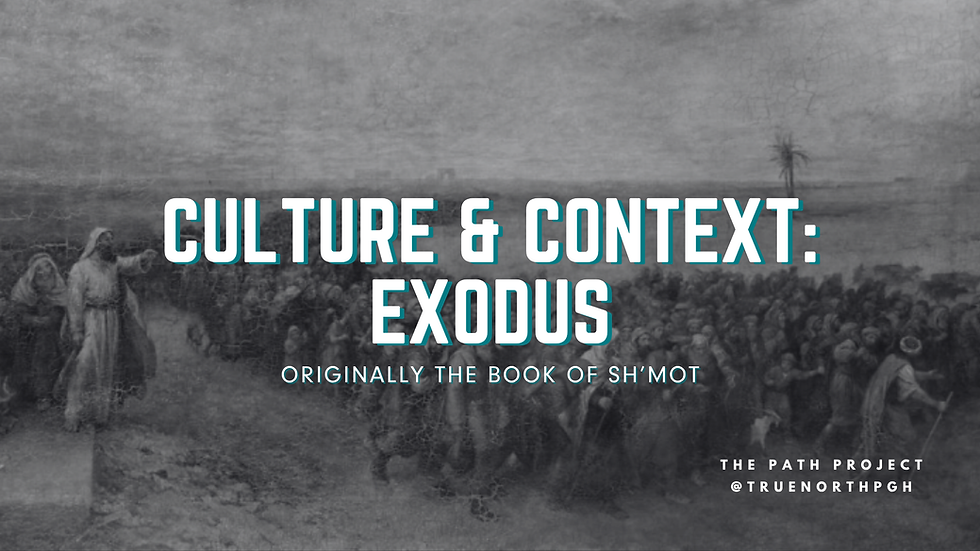
Welcome to Culture and Context, a blog that will flesh out the context of the PATH journal and other content that we study here at True North.
Year 1 folks: pat yourselves on the back! You made it through the 50 chapters of Genesis. Good news- the book of Exodus only has 40 chapters! Be strong- your exodus will pay off as you study the story of the Israelites on their journey to the promised land.
Can it be “fun” to study Exodus? Maybe the phrase should be “eye-opening” when we consider some of what we will see in this book. A burning bush. A pillar of cloud. A river of blood. Frogs falling from the sky! An entire Sea that splits and has a dry bottom to speed Israelites across to freedom. We have an opportunity to journal all of these miraculous and explosive events!
Even if you think you know all of these stories, try to approach them with a fresh perspective. Look for something new, something different. Ask God to show you how these biblical stories all fit together into something miraculous. And look for Jesus in Exodus. He is there in the sacrificial lamb of the first Passover. He is there as Living Water in Exodus 17. He is in the Tabernacle. Dr. Luke tells us that the resurrected Jesus appeared to two disciples on the road to Emmaus and told them of His story, beginning with Moses and the prophets:
"And he said to them, “O foolish ones, and slow of heart to believe all that the prophets have spoken! Was it not necessary that the Christ should suffer these things and enter into his glory?” And beginning with Moses and all the Prophets, he interpreted to them in all the Scriptures the things concerning himself." - Luke 24:25-27
The Merriam Webster dictionary defines exodus as a mass departure. In the Greek, exodus means “going out,” but remember, the Old Testament was not written in Greek. Exodus is not even the original name of the book. The Hebrew Bible calls it the book of Sh’mot, which means names. The ancient Hebrews did not see names as simply an identifier. Your name defined your character or destiny. The name Moses means drawn out, and Moses drew His people out of Egypt and onto the road to the Promised Land.
Just for fun- what does your name mean? Mine means Lady, and my maiden name meant “music performance hall;” I sang in choirs and churches for years. My married name means “builder or maker,” and as a production operator at church I facilitate the making of music during service. My parents did not know this when they named me, but God did! To highlight our pastor- the name Justin means just, upright or righteous, and its origin is from the Latin Justinus.
Back to Exodus, the book. Exodus is the second book of the Pentateuch, the first five books of the Old Testament. The ESV Study Bible’s introduction to Exodus summarizes the book this way: Exodus tells of God fulfilling his promise to Abraham by multiplying Abraham’s descendants into a great nation, delivering them from slavery in Egypt, leading them to the Promised Land, and then binding them to himself with a covenant at Mount Sinai.
Gustav Oehler in The Theology of the Old Testament notes that there is a blank in the history of the Hebrew people between Genesis and Exodus. He believes that it was a time of simple tribal history and not noteworthy. It was a time of population growth and the development of a nation of people that united into one community. Genesis ends with the death of Joseph, and then we get the opening of Exodus with the death of Joseph and all of his aforementioned generation.
The Hebrew people in Egypt began with Jacob and his twelve sons. The nation of Israel in Egypt started with 70 people. They were a fruitful group of people and grew large and strong enough to be a threat to their Egyptian neighbors. Exodus 1:8-22 tell the story of how the nation of Israel were enslaved and oppressed. The “joke” was on the Pharaoh because the more the people were oppressed, the more they multiplied.
What was life like for the Israelites while in Egypt? They were people of the promise of Abraham but they did not yet have the law or commandments. They maintained some of their tribal traditions; the tribes of Reuben and Gad, for example, continued to be cattle-breeders. Most lived in towns and led an agricultural life. Their politics continued to be tribal with family elders and with tribal officers who liaised with Egyptian overseers. Hebrew laws and education were influenced by the laws and education of Egypt, which was considered a more advanced culture.
Their cultural identity changed when they became enslaved. Their lives became miserable and the Israelites became bitter as their forced service became more and more impossible. They turned to God and He delivered them, giving them the identity of a nation delivered from slavery by God.
A basic outline of Exodus by Tremper Longman keeps God in the forefront:
God Saves Israel from Egyptian Bondage (chapters 1-18
God Gives Israel His Law (chapters 19-24)
God Commands Israel to Build the Tabernacle (chapter 25-40)
I really like Mr. Longman’s recommended approach to reading Exodus. He reminds us that this is ancient literature and does not contain what we are accustomed to in modern writing (chapters, page notations, plot development). It is history and narrative, but it is also divinely inspired and written a very long time ago.
Exodus is a Hebrew story, and Hebrew story-telling tends to be anonymous with a third-person narrator who already knows the ending. Of course, that narrator is God Himself, who knows everything. We learn about people like Moses through their recorded speech, rather than descriptions of appearance or motivation. We should not expect to learn about Moses or Aaron or Joshua in the same way that we learn the characters of contemporary books. Even our history books contain descriptions and motivations. A modern-day biography would be very short if it only contained peoples’ words!
Exodus is a single book but it is also one of five books of the Pentateuch. Most scholars believe that Moses wrote all five books, although parts of the Pentateuch were written after he died (for example, the account of his death in Deuteronomy 34), indicating that other anonymous authors helped to finalize the book. Remember that the final form of Exodus is accepted by the church as the inspired Word of God, written by a man who had been instructed in the wisdom of the Egyptians (Acts 7:22). The date of writing is accepted to be during Moses’ lifetime, or shortly after his death.
If you are interested in a deep dive into Exodus, I recommend Tremper Longman’s book How to Read Exodus, published by the Intervarsity Press. He goes extensively into Exodus as literature, history, God’s story and the Christian experience of reading Exodus.
Works Cited
From the website of the Fellowship of Israel Related Ministries: https://firmisrael.org/learn/shmot-meaning-exodus-hebrew-name/
Carpenter, E. (2016). Exodus. Lexham Press.
Elwell, W. A., & Comfort, P. W. (2001). In Tyndale Bible dictionary. Tyndale House Publishers.
Haas, G. H. (2003). Slave, Slavery. In T. D. Alexander & D. W. Baker (Eds.), Dictionary of the Old Testament: Pentateuch. InterVarsity Press.
The Holy Bible: English Standard Version. (2025). Crossway Bibles.
Lange, J. P., Schaff, P., & Mead, C. M. (2008). A commentary on the Holy Scriptures: Exodus. Logos Bible Software.
Longman, T., III. (2009). How to Read Exodus. IVP Academic.
Merriam-Webster, I. (2003). In Merriam-Webster’s collegiate dictionary. (Eleventh ed.). Merriam-Webster, Inc.
Oehler, G. F., & Day, G. E. (1883). Theology of the Old Testament. Funk & Wagnalls.
Platt, D., Akin, D. L., & Merida, T. (2014). Series Introduction. In Exalting Jesus in exodus. Holman Reference.
White, E. G. (1947). The Story of Redemption. Review and Herald Publishing Association.


